

PHP2Shell is a patching problem with a known fix, and every security team should close it this week. The more important story is how it was found: frontier AI models surfaced exploitable flaws that had survived more than a decade of human review in the language that powers roughly 70% of the web.
This post covers both. First, how Cyngular's agentic SOC finds your exposure, drives remediation and watches for exploitation while you patch. Second, why AI-driven vulnerability discovery changes the defensive math for good, and why the only realistic answer is defense that runs at the same speed.
What happened
On October 21, 2026, PHP shipped security releases fixing two critical flaws in the PHP engine itself, CVE-2026-109618 and CVE-2026-109619, both rated CVSS 9.2. Wiz Research named the pair PHP2Shell and reports that every PHP version released in the last decade, back to 5.4, is affected by at least one of them.
The bugs live in how PHP handles fatal errors, particularly out-of-memory errors, during request processing. A crashed request can leave corrupted state behind that the next request on the same worker reuses. Wiz demonstrated two outcomes from that:
- Unauthenticated remote code execution on the latest container images of WordPress, Drupal and Joomla.
- Heartbleed-style memory disclosure that leaks passwords, session tokens, API keys and certificates from PHP worker memory, without needing RCE.
Because the flaws sit below the application layer, a clean codebase does not help. Wiz notes that even a "Hello World" app on an affected version can be vulnerable.
| Item | Detail |
|---|---|
| CVEs | CVE-2026-109618, CVE-2026-109619 (CVSS v4.0 9.2) |
| Affected | Every PHP version back to 5.4, per Wiz |
| Fixed releases | 8.5.12, 8.4.27, 8.3.36, 8.2.35 (PHP release notes) |
| No fix | PHP 8.1 and older are end of life and receive no patch |
| Impact | Pre-auth RCE; leakage of credentials and secrets from process memory |
| Discovered by | Wiz (Wiz Atlas, Gemini 4 Argon, GPT-5.6 Sol) and, independently, Calif with an OpenAI model |
Wiz is explicit that the exploit chain sat at the edge of what human researchers could practically build. With frontier models, one researcher finished in a week what would previously have taken a world-class team months. Hold that thought; it is the second half of this post.
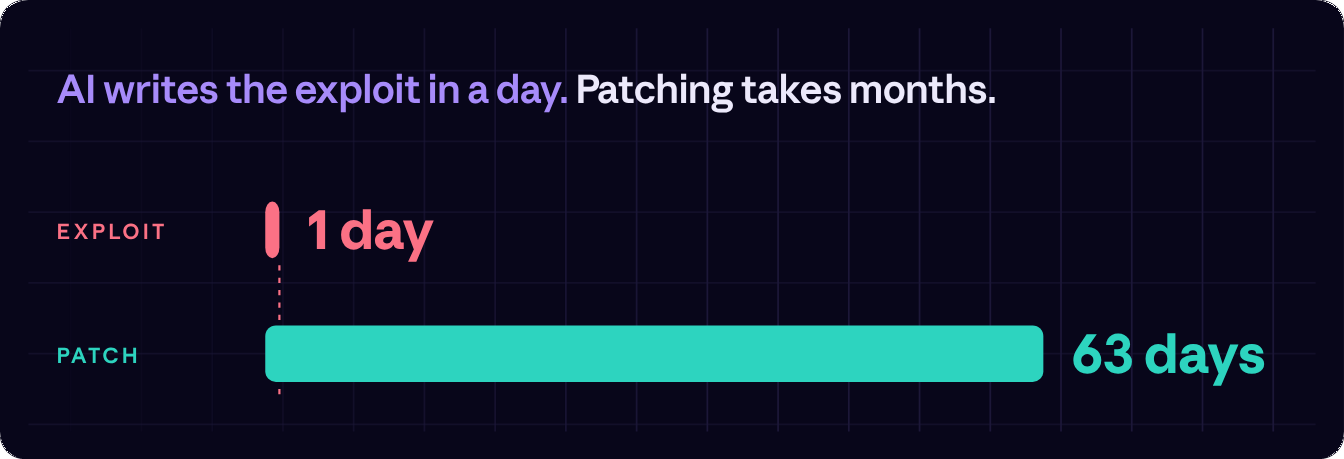
Compare the two bars in Figure 1. With AI, the exploit was ready one day after the first finding. The 63 days it took to ship a patch were affordable only because researchers, not attackers, found the bug first. With the same models available to attackers, the next critical flaw may arrive with no warning at all, so protection cannot depend on a patch existing.
How Cyngular's agentic SOC covers you
The tactical response to PHP2Shell is simple: find every vulnerable PHP runtime and patch it. The hard part is doing that completely across a cloud estate and covering the window before the last workload is fixed. Cyngular's agentic SOC runs that as one continuous plan:
- 1Hunt for exposure. Agents inventory PHP runtimes across VMs, containers, images and serverless workloads in your cloud accounts and flag every version below 8.5.12, 8.4.27, 8.3.36 or 8.2.35. Internet-facing workloads are ranked first, since the attack is unauthenticated.
- 2Drive the fix. Each finding goes to its owner with the exact target version. Workloads on PHP 8.1 or older are flagged as upgrade projects, because no patch exists for them.
- 3Cover the gap. Until patching is done, we verify that WAF and edge mitigations from your provider are actually enabled on the exposed assets. Cloudflare, Fastly, Akamai and others published PHP2Shell rules for exactly this window.
- 4Watch for exploitation. Agents monitor for the behavioral signals Wiz published: unusual multipart requests followed by memory-limit errors or bursts of HTTP 500s, oversized or malformed
PHPSESSIDcookies, and unexplained PHP worker churn. - 5Assume secrets leaked. The memory-disclosure bug can expose cloud keys and tokens without leaving an RCE trail. We identify credentials reachable from vulnerable PHP processes, recommend rotation, and hunt cloud audit logs for those identities acting from new sources or performing unusual actions.
- 6Verify closure. Rescans confirm each workload is on a fixed version, and the case closes only when exposure and rotation are both done.
Step 5 is where most patch-only responses fall short. A vulnerable server that was patched last night may already have handed over the keys to your cloud, and the follow-on activity shows up in identity and control-plane telemetry, not on the web server. That is exactly the layer a cloud MDR is built to watch.
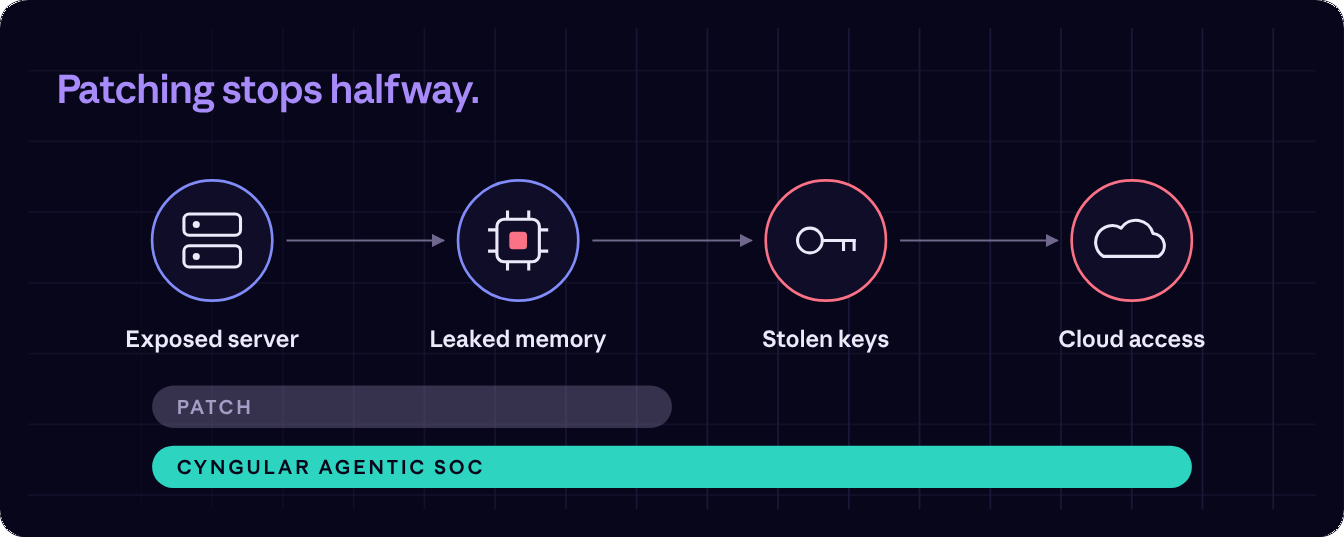
Figure 2 is why the plan above does not stop at patching. A patch stops the server from leaking. The stolen keys and the cloud access that follows run on valid credentials taken before the fix, and they appear only in identity and cloud audit logs. Those are the layers the agentic SOC keeps watching.
The bigger story: AI now finds the bugs
PHP2Shell is not an outlier. In 2026, AI-assisted research became a measurable source of new vulnerabilities, and the flaws it finds skew toward the kind attackers want: remote code execution in core runtimes and libraries.
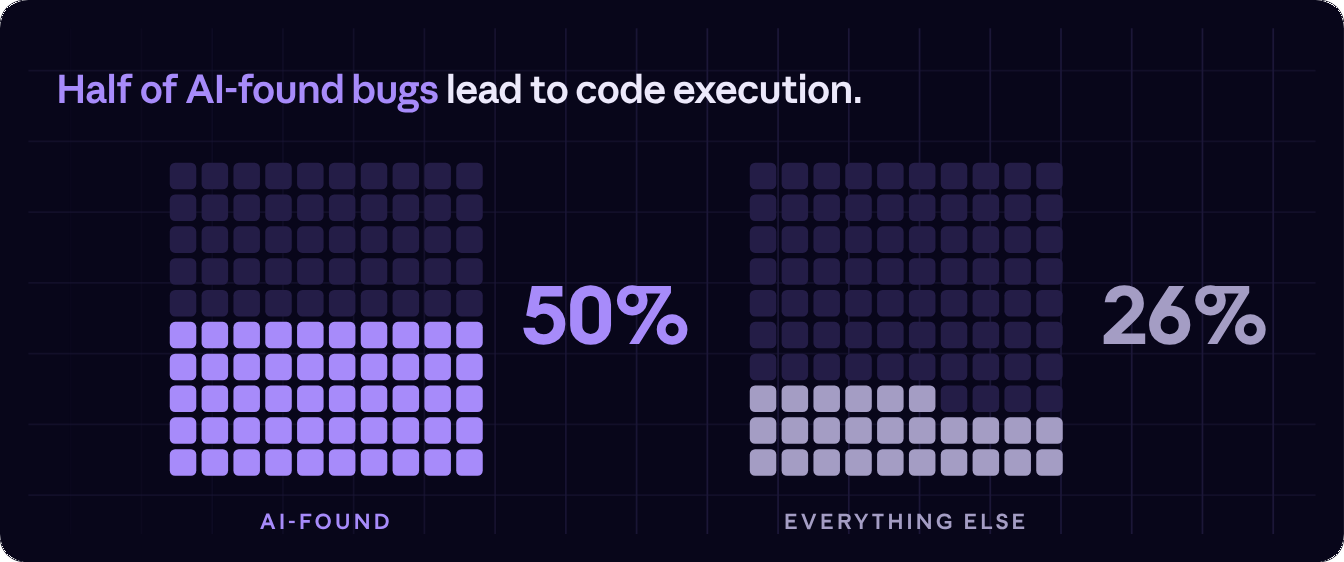
Figure 3 shows that AI is not just finding more bugs; it is finding the dangerous kind. Half of AI-found vulnerabilities lead to remote code execution, about twice the rate for everything else. Attackers can run the same models, and those are exactly the flaws they hunt for.
| Finding | Figure | Source |
|---|---|---|
| Monthly CVE disclosures, Jan to Aug 2026 | 5,045 to 10,740 (more than doubled) | Google Threat Intelligence Group |
| Vulnerabilities attributed to AI-assisted discovery, as of mid-2026 | 1,061 | VulnCheck |
| Vulnerabilities exploited in the wild, Jan to Aug 2026 | 141, already above the 127 for all of 2025 | GTIG |
| Median time from CVE publication to known exploitation | 120 days in 2025, 80 days in 1H 2026 | VulnCheck |
| Share of 1H 2026 known exploited vulnerabilities in content management systems | One third | VulnCheck |
Two caveats keep this honest. GTIG notes that public data undercounts AI discovery, since CVE records carry no AI attribution field and cloud providers often fix AI-found bugs silently. VulnCheck found that only 1.3% of AI-discovered vulnerabilities have been confirmed as exploited so far, roughly the same rate as all vulnerabilities. AI is not yet producing a flood of exploited zero-days.
What it is changing is the economics. GTIG attributes most of 2026's growth in exploitation to fast weaponization of already-disclosed bugs, and suggests attackers are using LLMs to diff patches and adapt public proof-of-concept code. That is precisely the PHP2Shell risk: the patch is public, the root cause is documented, and Wiz states that LLMs can adapt the exploit to different PHP versions, configurations and memory layouts. A bug class that once required a world-class team now requires a capable operator with a model. The last row in the table matters too, because PHP is the runtime under most of those CMS targets.
Why defense has to be agentic too
If attackers use AI to find and weaponize flaws, defense that runs at human speed loses on arithmetic. Google's threat intelligence group reaches the same conclusion, recommending that organizations move from unprioritized mass patching to intelligence-driven triage combined with automated, agentic remediation.
Three things follow for any security program:
- Exposure has to be known continuously, not quarterly. When a CVE like PHP2Shell drops, the question "where are we running this?" should be answered in minutes. Agents that keep a live inventory of runtimes and internet exposure across cloud accounts make that possible.
- Patching will always trail disclosure, so detection has to cover the gap. Many vulnerable workloads will run for days or weeks after a fix ships. The defense in that window is behavioral detection and fast containment, not a ticket queue.
- The blast radius lives in identity and the control plane. Modern intrusions move from an exposed workload to stolen credentials to cloud APIs. Investigating that chain means correlating workload, identity and audit-log telemetry at machine speed, then acting on it.
This is the model Cyngular is built on. Our agentic SOC runs the investigation work that used to wait for an analyst: it hunts for new exposure as soon as a threat emerges, correlates signals across cloud, identity and workloads, and drives each case to remediation, with our analysts directing and validating the agents. The next PHP2Shell will not come with months of warning. The response should already be running when it lands.
What to do this week
- 1Inventory every PHP runtime across VMs, containers, base images and managed hosting, and flag anything below 8.5.12, 8.4.27, 8.3.36 or 8.2.35.
- 2Patch internet-facing workloads first; schedule upgrades for anything on PHP 8.1 or older.
- 3Confirm your WAF or CDN provider's PHP2Shell rules are enabled on exposed assets until patching is complete.
- 4Rotate credentials, tokens and API keys reachable from vulnerable PHP processes.
- 5Review cloud audit logs for those identities acting from new sources since mid-October.
Cyngular customers are already covered by the hunt and detection plan above. If you are not a customer and want help assessing your exposure, talk to our team.
Sources
- Wiz Research, PHP2Shell: AI uncovers critical RCE vulnerabilities affecting 70% of the Internet, October 21, 2026
- PHP, security release announcement, October 21, 2026
- Google Threat Intelligence Group, Vulnerability Discovery and Exploitation Trends in the AI Era, September 30, 2026
- VulnCheck, State of Exploitation 1H-2026, July 28, 2026
The Cyngular take
Cyngular's agentic SOC correlates activity across identity, SaaS and cloud so sequences like this one surface as a single investigation — not a scatter of benign-looking events.